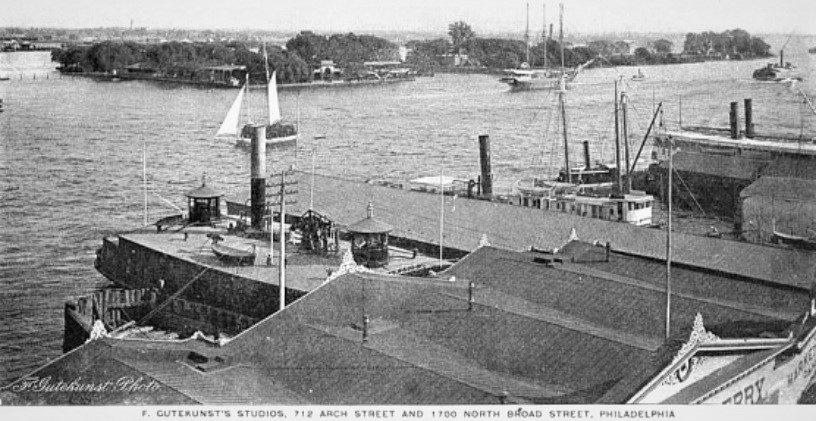
Public Ledger 1 Apr 1921
Showing posts with label Phila. Show all posts
Sunday, November 8, 2020
Thursday, March 5, 2020
Gray's Alley - To Gatzmer Street / Tun/Ton Alley 1875-1910
![]() |
| Phila.Atlas Wards 2 through 20, 29, 31 - 1875 |
It would appear that references to Gray's Alley also refer to a later name change to Gatzmer Street around mid 19th century. Also extension of Gatzmer Street passed Water Street to waterfront via Tun/Ton Alley. Tun Alley as in Tun Tavern, Water Street and Tun Alley, 18th century.
![]() |
| circa 1800 |
(above: Philadelphia and Her Merchants as consituted fifty to seventry years ago by Adam Ritter. 1860)
![]() |
| Bromley 1895 Map |
![]() |
| Bromley 1910 Map . |
Monday, March 2, 2020
Saint Anthony Finds A Home - by Mirella Zell - The Miami Voice - 24 October 1980
Finding the "right" new home for an object that has been kept in our midst for years but can no longer remain can be a difficult job.
But the quest for a new home for a life-size statue of St. Anthony of Padua became double difficult because the artist, Amelie Zell Wright, is a fervent devotee of the saint, and the statue had always been with her at home.
Many persons kindly offered to accept the statue as a gift and place it in a garden, in a Florida room, "anywhere" that would substitute for the room the artist now lacked. But "just anywhere" was not the answer.
The new home and the right welcome by one and many was finally found when Msgr. David E. Bushey, Pastor of St. Brendan's, 8725 S.W. 32nd St., Miami, extended an invitation to have the statue become a permanent guest of the parish.
The St Anthony statue now at St. Brendan's is the plaster replica of a life size bronze figure commissioned in the early 50's by Mr. and Mrs. Leonard. The Leonards were and are fervent devotees of the saint.
When the statue was finished, the artist recalls the couple was very pleased with the way she had captured in clay, then into bronze, the reverent concept they shared about the great saint. With permission from the Leonards, Mrs. Wright reproduced the statue to keep in her own home, which she did until she moved into the small apartment complex where she now resides. ...
Mrs. Wright graduated with honors from Academia Nacional de Bellas Artes "San Alejandro" in her native Havana, Cuba, and from the Pennsylvania Academy of Fine Arts in Philadelphia. Her work, much of which consists of massive life-size sculptures, is exhibited in many private collections and museums both in Cuba and the United States.
She now devotes her time to teaching ceramic arts and crafts to retirees and working on small figures done in her favorite medium, terracotta. ...
https://phillyandstuff.blogspot.com/2013/07/amelie-zell-felton-cuban-born.html
.
Tuesday, February 18, 2020
Centennial of the Launching of the Big Ships U.S. Navy - August 1897 - Philly
A possible event connected to the famous 1897 Street Scene Photo (off of a stereograph photo card by "B.W. Kilburn and Company" - Library of Congress) above between 7th and 8th Street on Market Street and the crowds main focus looking east toward 6th Street may be a G.A.R. Grand Army of the Republic, Naval veterans posts event celebrating the launch in Spring 100 years prior, the centennial, of the original 6 ships of the first Official Navy under the U.S. Constitution and the ships built with funds authorized by Congress in 1794. Launched from six shipyards along the east coast in 1797.
The event commemoration on August 12, 1897 was at Independence Hall starting at 12:30 PM.
I would imagine with speeches and music the Navy Vets would have been there at least two hours. And the Vets in parade form then marching over to the Arch Street Wharf, may have used 6th Street - the reason for people in balconies at 7th Street trying to get a glimpse of the then moving event amidst the flags and bunting etc. on Market Street, the main drag through Philly.
A typical muggy Philly August afternoon with a slight overcast of clouds to mute the shadows and direction of shade to indicate a time frame of the day.
That and some folks wanting to take a Ferry over to Washington Park in Deptford Township NJ to get a view of yacht racing and mock naval battles off Fort Mifflin in the late afternoon into evening.
Tuesday, November 26, 2019
Mike Donovan vs. Jimmy Murray - Middleweight Championship Fight - Smith's Island, Delaware River - circa 1873
![]() |
| Smith and Windmill Islands (top), Delaware River off Philadelphia Removed by Federal Gov't 1894 |
..."I got sick of the gang I traveled with in New York, and, knowing that Ned O'Baldwin was in Philadelphia, I went there.
"After a short time I succeeded in getting a match for the middleweight championship with Jimmy Murray, who then held that title.
"Murray was a wonderful athlete. He could do many things. He could put the shot, and he could also jump backwards further than any man I ever saw. He could jump backwards ten feet without weights in his hands. He could jump on a bar in a saloon backwards, and jump over a bar front- wards without touching his hands to it.
"I have a painting of him that I would not take a thousand dollars for.
"As soon as Jimmy Murray and I were matched, Ned O' Baldwin and I started around the country giving boxing exhibitions. ...
"The fight took place (on Smith's Island) a short distance from Philadelphia.
"We didn't pitch a ring, for fear of the police. The crowd of sports that had assembled from various directions formed the ring by grasping fingers with arms folded across the chest.
"I found Murray the hardest-fisted man I ever fought. His blows hurt me, and the scars you can see on my face and forehead now. My lips were all cut up and my nose was broken. I was awfully punished — blind as a bat for three days afterwards.
"The ring as formed by the crowd broke up after a while, but we fought in about a twenty-four- foot space.
"Barney McMullen was referee. Patty Ryan of Philadelphia and Pete King seconded me. Johnny Clark and one other, I have forgotten his name, seconded Murray.
"Murray weighed about one hundred and fifty- six pounds and I weighed about one hundred and forty-eight. He was eight pounds heavier than I and he was stronger, but I had the endurance. When the fight broke up at the arrival of the police I was as strong and confident as at the beginning. I had youth on my side.
"We were both good long-range fighters, and during the first part of the fight, we confined our attack to outfighting, but as the fight went on we warmed up to it and did considerable infighting. Jimmy was as good an infighter as I.
"One thing, I believe, helped me in this fight. I never could stand anything tight about my legs. I asked Mrs. Carol, my good friend, the boarding house keeper, what I could do about getting rid of the elastics around my stockings, and she fixed it by sewing buttons on them and making buttonholes in my breeches so I had no trouble about the circulation of blood in my legs. That has licked many a man.
"At the commencement of the forty-fourth round somebody yelled 'Police!' I dusted for the tall timber. Some jumped in boats, others ran across country; the crowd scattered in all directions.
"I hid in the woods. As I lay there I could hear them say: 'He is around here somewhere.'
"Finally a big Dutchman found me, and he said :
" 'Here he is,' and he grabbed me.
" 'Don't yank me like that.' I was sore ; and Sergeant Moore, whom I met many times afterward, said : 'Let go of that man ! He will go along with us.'
"I walked along quietly, and before I got across the river I was as blind as a bat.
"When we arrived at the station house, there was Jimmy Murray. They had caught him too. We were committed to Moyamensing, and were there four days.
"The jailer — I think his name was Dailey — had known me before, and he said when he saw me: 'You're a picture!'
"I said, 'Yes, I suppose so, but I will have to take your word for it. I can't see.'
"Murray and I were being led to a cell when the Headkeeper said : 'Don't put those two men in the same cell.'
"I remarked: 'Why not? We're not bad friends. We had all the fight we wanted this morning.' So they put us together, and we were there for four days.
"Murray took care of me as a mother would have taken care of a sick child. I had caught cold in my eyes and I was helpless. Jimmy would sit by the hour and bathe my eyes with water with a handkerchief he had obtained from the jailer.
"I was dying to get a look at him. On the fourth day I stretched the lid of one of my eyes so I could just peak out, and I closely scanned his face. There I saw lumps standing out all over his face. He had a harder face than I, and yet, during the fight, I couldn't notice that my blows had any effect. It seems that the swelling came afterwards.
"Well, I fell back and laughed heartily, happy as a lord.
" 'What are you laughing at, you swine?' he said.
" 'Jimmy, I'm satisfied,' I replied. 'I did some handiwork, anyway. I thought I had not punished you at all.'
" 'Well,' he said, 'is that what you have been thinking about the last three days I have been caring for you?'
"Murray and I were the best of friends ever after.
"Murray retired after this fight, taking a position in the Boxing and Fencing Club of Philadelphia."
(Source: Mike Donovan; the making of a man, by Marshall Stillman. 1918)
.
Monday, November 25, 2019
Excerpts Inquirer Obit - Undefeated Middleweight Champion Mike Donovan - 25 Mar1918
In his day Donovan taught the art of self-defense to more prominent men, including bankers, brokers, merchants and statesmen, than any other boxing professor in America. He was idolized by them all. for he was not only a great teacher, but a like-able man as well. One of his staunchest admirers was Theodore Roosevelt, who received his early physical training from Donovan.
Donovan came to this city in 1873, where he married Miss Cecilia Butler and it was a most happy marriage. Fifteen children were born to them, nine of whom arc now alive, six girls and three boys.
Donovan's next stopping place was this city, and he soon became well known here. His first fight of note was with Jimmy Murray. It was called a draw after a battle of forty-three'rounds, lasting one hour and five minutes. The ring was pitched on Smith's Island, in the Delaware River, and the battle was for a purse of $100. The bout was witnessed by only a small crowd, because, the police had the tip and, many of the regulars remained away, fearing arrest.
I spent the happiest days of my life in dear old Philly, and what great sessions we used to, have at Johnny Clark's, Arthur Chambers', Billy McLean's, McGees' on Second street, and the old Comique. In those days you could not get by with any four-flush methods. You had to get out and meet all comers, and some rare old birds they used to trot out to meet the champions who would go to Philadelphia, to fill a week's engagement at the different boxing resorts. Murray was one of the cleanest boxers I ever met and I shall never forget our fight on the island. We did not have a regular ring, but fought on the turf with the bare hands.
The ring was formed by the crowd circling around us. It was a great fight, and one of the hardest I ever had, for I was almost blind from his blows. I still have some scars of that fight. Look here, look into the corners of my eyebrows, close to the bridge of my nose; see those two scars? Those are two places he cut me with those hard hands of his.
Yes, we were both arrested and taken to Philadelphia. At the jail they wouldn't put Murray and myself in the same cell at first, because they believed we would continue the fight. I finally convinced the warden that I couldn't fight, even if I wanted to, because I could not see. It took me nearly four months to recover from that fight.
Library of Congress
.
Thursday, November 21, 2019
Dennis F Butler "The Champion Swimmer of America" - The National Police Gazattee 22 Aug 1885
PROF. DENNIS F. BUTLER.
[With Portrait.]
Butler's first race was with Thom. Coyle, of Chester, from the Horseshoe buoy (Delaware river, below Gloucester, N. J.), 7-1/2 miles. He won easily, with 15 to 20 minutes to spare. In 1878 he swam Robert Ward, of Canada, 5 miles, on the Delaware river (from the waterworks to Smith's Island), winning easily. He defeated Chas. Rice in a 5-mile ocean swim, Rice giving up after swimming 2-1/2 miles. In 1878 he beat George Wade and twenty-five competitors for the championship of America and gold medal at the New York Athletic Club regatta. Time, 19 minutes 4 seconds, In 1978 he beat John Thomas, of Canada, 3-1/2 miles, on the Delaware river. In 1879 he beat Blondell, of Baltimore, Md., at Bear Creek, Md.,5 miles. In 1879 he beat Chas. Rice, of long Branch, and twenty-three contestants at Cape May, 5 miles, making the fastest time in the world for 5 miles. In 1880 he was appointed life guard at Atlantic City, And met and defeated Tom Coyle, of Chester, PA. (who swam Johnson for championship of the world), in a mile ocean swim. Coyle being dissatisfied another swim took place. Coyle again suffering defeat.
After repeated challenges to the Bradford brothers (life guards at Atlantic City) and all other ocean swimmers, and not being able to get a match with them, he returned to Philadelphia. He then gave a sweepstake swimming match in October of the same year, distance 7-1/2 miles, on the Delaware river, beating twenty-one swimmers, among them being Tom Coyle of Chester, Pa.; Joe Morrow, of Philadelphia; John Dunk and Borgiana of Philadelphia. In 1881 he swam Joe Morrow from Chester to Philadelphia, a distance of 15 mile. Alter leading by 2 miles for 12 miles be was taken with cramps. Morrow being awarded the purse and championship, in 1884 was engaged at Hanlan's Point, Can., to give swimming exhibitions, and was matched with Joe Smith, the Canadian champion 2 mile swimmer, $50 being put up as forfeit to bind the match. Smith paid forfeit, being afraid to swim. He again challenged all Canada, offering 100 yards start in a mile race. Not being able to get a match he returned to Brooklyn. N. Y., to accept the position of assistant with Prof. Mike Donovan in his Brooklyn gymnasium. Butler is also a noted sparrer, walker and runner.
.
Saturday, September 7, 2019
Thursday, August 8, 2019
Thursday, July 25, 2019
Wednesday, July 24, 2019
Saturday, June 8, 2019
Plenty of Toys in Shadow of War - Domestic vs. Imported - A. Schoenhut Company - Public Ledger 23 Nov 1914, Pg.3
FINE AMERICAN-MADE DOLLS.
Perhaps the .fjnest American-made dolls on the market are made by the A. Schoenhut Company, of Philadelphia. They are made of all wood and can do most everything but talk. They can stand, sit, assume the poses of the most modern dances, play football and at least talk with their hands.
The Schoenhut dolls are really "companionable" more so, perhaps, than "the big blue-eyed babies" with the typical doll faces and a vacant doll stare. Albert F. Schoenhut said yesterday that it had been the object of the firm since it was established by his father, Alfred Schoenhut, more than 40 years ago, to make instructive as well as amusing toys.
The all-wood dolls are natural. They look like little neighbors. Every joint is flexible and practically unbreakable. As Mr. Schoenhut said: "Fancy bisque heads break easily, and every father knows that he can replace the head only at considerable expense; but to the child the doll is never the same. It may be a case of love at first sight, but when a child loves a doll. If the doll breaks, the child's little heart is likely to follow suit"
Dolls are a great institution, as all children will agree. They were used by the early Egyptians, and the doll army has invaded and captured the world.
War or no war, with American-made dolls among the finest, or at least among the most "intelligent," with the country well stocked with all kinds, of toys, the children, as said before, "need not worry." As the old pessimist would say, they will have enough to contend with when they grow up.
.
Tuesday, May 28, 2019
Sunday, May 5, 2019
Tales and Players - Sansom Square (700 Block Sansom Street) - 1892
704 Sansom Street - Hanson Brothers - Electrotypers
710 Sansom Street - J.M.Armstrong Co. - Music Typographers
720 Sansom Street - George C. Price - Watchmaker
730 Sansom Street - Davis & Galt - Silversmiths
734 Sansom Street - D. V. Brown - Wholesale and Manufacturing Optician
705 Sansom Street - Albert A. Ardis Jr. - Bricklayer and Builder
705 Sandom Street - Louis J Meyer - Gilder, Electro Silver Plater
711 Sansom Street - Smith & Pyle - Lapidists
721 Sansom Street - Mansfield Bros. - Printers
(711 Sansom Street - Former Tenant - J. Koenig and Co. - Manufacturers of Musical and Mathematical Instrument Cases)
Subscribe to:
Posts (Atom)